VICTORIA — The 2026 property assessments, which reflect market value as of July 1, 2025, have been announced for property owners of about 400,000 properties throughout Vancouver Island. The updated property values are now available at bcassessment.ca in addition to 2026 Property Assessment Notices being mailed to each property owner.
“The Vancouver Island housing market has been generally quite stable, which is reflected in the 2026 property assessments," says BC Assessment Deputy Assessor Matthew Butterfield. "Most homeowners can expect minimal assessment value changes in the range of -5% to +5%."
As B.C.'s provider of property assessment information, BC Assessment collects, monitors and analyzes property data throughout the year. The newly released 2026 property assessment details can be searched and accessed any time at
bcassessment.ca by using BC Assessment's Assessment Search online service.
Overall, Vancouver Island's total assessments increased from almost $391 billion in 2025 to almost $399 billion this year. About $4.71 billion of the region's updated assessments is from new construction, subdivisions and the rezoning of properties.
The Vancouver Island region includes all communities located within Greater Victoria, South Island, Central Island, North Island, the West Coast, Northern and Southern Gulf Islands and Powell River.
The summaries below provide estimates of typical 2025 versus 2026 assessed values of properties throughout the region.
These examples demonstrate market trends for
single-family residential properties by geographic area:*
Single Family Homes
Changes by Community |
2025 Typical
Assessed Value
as of July 1, 2024 |
2026 Typical
Assessed Value
as of July 1, 2025 |
%
Change |
|
Greater Victoria |
| City of Victoria | $1,113,000 | $1,128,000 | +1% |
| District of Saanich | $1,157,000 | $1,164,000 | +1% |
| Township of Esquimalt | $1,015,000 | $1,014,000 | 0% |
| District of Oak Bay | $1,630,000 | $1,647,000 | +1% |
| Town of View Royal | $1,095,000 | $1,089,000 | -1% |
| City of Colwood | $996,000 | $982,000 | -1% |
| City of Langford | $947,000 | $951,000 | 0% |
| District of Metchosin | $1,243,000 | $1,221,000 | -2% |
| District of Highlands | $1,263,000 | $1,231,000 | -3% |
| District of Sooke | $797,000 | $786,000 | -1% |
| District of Central Saanich | $1,082,000 | $1,091,000 | +1% |
| District of North Saanich | $1,346,000 | $1,366,000 | +1% |
| Town of Sidney | $938,000 | $953,000 | +2% |
Gulf Islands
| $856,000 | $867,000 | +1% |
|
Central Island |
| Town of Ladysmith | $710,000 | $723,000 | +2% |
| Town of Lake Cowichan | $589,000 | $606,000 | +3% |
| City of Duncan | $568,000 | $592,000 | +4% |
| District of North Cowichan | $727,000 | $733,000 | +1% |
| District of Lantzville | $942,000 | $944,000 | 0% |
| City of Nanaimo | $760,000 | $769,000 | +1% |
| Town of Qualicum Beach | $920,000 | $904,000 | -2% |
| City of Parksville | $750,000 | $774,000 | +3% |
| District of Tofino | $1,511,000 | $1,496,000 | -1% |
| District of Ucluelet | $746,000 | $784,000 | +5% |
| City of Port Alberni | $500,000 | $485,000 | -3% |
|
North Island |
| City of Courtenay | $731,000 | $752,000 | +3% |
| Town of Comox | $830,000 | $838,000 | +1% |
| Village of Cumberland | $804,000 | $808,000 | 0% |
| City of Campbell River | $678,000 | $680,000 | 0% |
| District of Port Hardy | $360,000 | $370,000 | +3% |
| Village of Port Alice | $334,000 | $335,000 | 0% |
| Town of Port McNeill | $442,000 | $434,000 | -2% |
| Village of Gold River | $329,000 | $333,000 | +1% |
| Village of Tahsis | $201,000 | $204,000 | +2% |
| Village of Alert Bay | $300,000 | $320,000 | +7% |
| Village of Sayward | $370,000 | $370,000 | 0% |
| Village of Zeballos | $153,000 | $161,000 | +5% |
|
Powell River |
| Powell River Rural Areas | $490,000 | $489,000 | 0% |
| City of Powell River | $575,000 | $580,000 | +1%
|
*All data calculated based on median values.
These examples demonstrate market trends for
strata residential properties (e.g. condos/townhouses) by geographic urban area for select urban communities:*
Strata Homes
(Condos/Townhouses)
Changes by Community |
2025 Typical
Assessed Value
as of July 1, 2024 |
2026 Typical
Assessed Value
as of July 1, 2025 |
%
Change |
|
Various Urban Areas |
| City of Victoria | $561,000 | $551,000 | -2% |
| District of Saanich | $597,000 | $597,000 | 0% |
| Township of Esquimalt | $562,000 | $559,000 | -1% |
| District of Oak Bay | $815,000 | $823,000 | +1% |
| City of Langford | $562,000 | $556,000 | -1% |
| Town of View Royal | $634,000 | $649,000 | +2% |
| City of Colwood | $640,000 | $637,000 | 0% |
| District of Central Saanich | $661,000 | $677,000 | +2% |
| Town of Sidney | $631,000 | $650,000 | +3% |
| City of Nanaimo | $443,000 | $451,000 | +2% |
| City of Courtenay | $450,000 | $448,000 | 0% |
| City of Campbell River | $419,000 | $412,000 | -2%
|
*All data calculated based on median values.
BC Assessment's website at
bcassessment.ca includes more details about 2026 assessments, property information and trends such as lists of 2026's top valued residential properties across the province and an interactive map.
The website also provides self-service access to a free, online property assessment search service that allows anyone to search, check and compare 2026 property assessments for anywhere in the province. Property owners can also download a digital copy of their 2026 property assessment.
“Property owners can find valuable information on our website including answers to many assessment-related questions, but those who feel that their property assessment does not reflect market value as of July 1, 2025 or see incorrect information on their notice, should contact BC Assessment as indicated on their notice as soon as possible in January," says Butterfield.
“If a property owner is still concerned about their assessment after speaking to one of our appraisers, they may submit a Notice of Complaint (Appeal) by February 2, for an independent review by a Property Assessment Review Panel," adds Butterfield.
The Property Assessment Review Panels, independent of BC Assessment, are appointed annually by the provincial government, and typically meet from early February to mid-March to hear formal complaints.
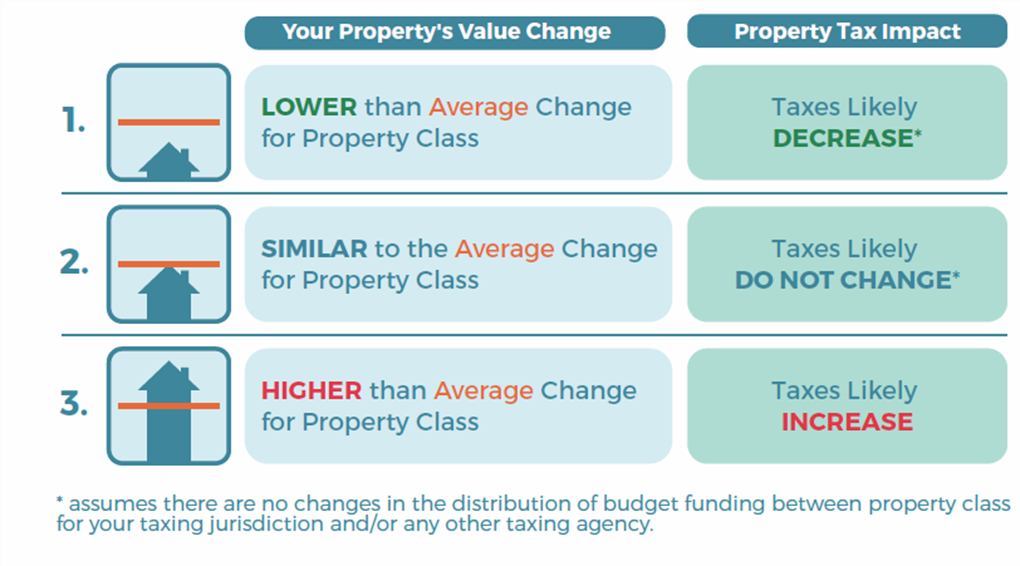
"It is important to understand that changes in property assessments do not automatically translate into a corresponding change in property taxes," explains Butterfield. "As indicated on your assessment notice, how your assessment changes relative to the average change in your community is what may affect your property taxes."
Have questions?
Property owners can contact BC Assessment toll-free at 1-866-valueBC (1-866-825-8322) or online at
bcassessment.ca. During the month of January, hours of operation are 8:30 a.m. to 5:00 p.m., Monday to Friday.
Media contacts:
Email:
media@bcassessment.ca
MEDIA BACKGROUNDER
Facts on B.C. Property Assessments
- Total number of British Columbia properties assessed in 2026 is 2,233,648, about a one percent increase from 2025.
- Total value of British Columbia real estate in 2026 is more than $2.75 trillion, a decrease of almost 2.5 percent from 2025.
- Total amount of British Columbia non-market change for 2026, including new construction, rezonings and subdivisions is approximately $34.7 billion, a decrease of about 9.4 percent from 2025's $38.3 billion.
- In B.C., approximately 91 percent of all properties are classified with some residential (Class 1) component.
- Over 98 percent of property owners typically accept their property assessment without proceeding to a formal, independent review of their assessment.
- Assessments are the estimate of a property's market value as of July 1, 2025 and physical condition as of October 31, 2025. This common valuation date ensures there is an equitable property assessment base for property taxation.
- Changes in property assessments reflect movement in the local real estate market and can vary greatly from property to property. When estimating a property's market value, BC Assessment's professional appraisers analyze current sales in the area, as well as considering other characteristics such as size, age, quality, condition, view and location.
- Real estate sales determine a property's value which is reported annually by BC Assessment. Local governments and other taxing authorities are responsible for property taxation and, after determining their own budget needs this spring, will calculate property tax rates based on the assessment roll for their jurisdiction.
- Our property assessments provide the foundation for local and provincial taxing authorities to raise nearly $12 billion in property taxes each year. This revenue funds the many community services provided by local governments around the province as well as the K-12 education system.
- BC Assessment's website provides a listing of property assessments and sales to help property owners understand their property's market value and provide comparable sales information. Go to bcassessment.ca and try our Assessment Search tool.
- For more information on property assessments, real estate market trends, and lists of the province's top valued residential properties, please visit bcassessment.ca and click on the Property Information & Trends link.